Smart Hospitals: Modular, AI-Driven Healthcare Infrastructure
introduction
Modern healthcare solutions are transforming hospitals into “smart” centers of care. Faced with growing patient demand and staff shortages, hospital leaders are investing in digital infrastructure that automates workflows, enhances connectivity, and integrates medical devices. According to an article published on Philips website, by 2025, over 90% of healthcare executives view automation as critical to relieving clinical staff from routine tasks. Innovations like generative AI assistants can summarize clinical notes, interpret imaging data, and translate complex reports into plain language, giving care teams more time with patients. In this way, smart hospital systems—from hospital automation to AI-driven analytics—are delivering better care to more people with greater efficiency.
- For example, patient-monitoring systems now form open, interoperable networks. Connected monitors and medical devices feed into unified dashboards, so clinicians instantly see a patient’s vital signs, imaging, and lab results in one view. This vendor-neutral interoperability breaks down data silos, enabling advanced algorithms to predict risks (like sepsis or cardiac events) before they occur.
- Generative AI tools are emerging as virtual assistants for clinicians. Philips reports that 85% of healthcare leaders plan to invest in generative AI by 2027. AI can auto-generate discharge summaries or patient instructions, freeing nurses and doctors from administrative paperwork.
- Telehealth and remote monitoring have also matured. Advanced telemetry devices and home-based IoT sensors allow patients to be cared for “hospital-at-home,” easing capacity constraints. In fact, one survey found that 41% of healthcare leaders plan to deploy AI-driven remote monitoring in the next three years. These systems continuously track symptoms (heart rate, glucose, etc.) and alert clinicians to issues early, improving outcomes and reducing readmissions.

AI-Driven Healthcare System Solutions
Artificial intelligence is at the core of next-generation medical systems projects. Hospitals are shifting from pilot programs to enterprise deployments of AI tools that improve clinical and operational workflows. For example, ambient listening devices (AI microphones) automatically transcribe doctor-patient conversations, auto-populating electronic health records and coding charts. This reduces burnout and allows clinicians to focus on the patient. Other AI applications include:
- Diagnostics: Machine-learning models analyze medical images (CT, MRI, X-ray) and pathology slides to detect findings faster and more consistently than before. Already, AI aids in radiology and pathology, and Philips notes a “silent revolution” in image-guided care for interventions and surgery.
- Predictive Analytics: By combining a patient’s entire digital record with thousands of similar cases, AI algorithms can recommend personalized treatment plans and alert staff to impending crises. For instance, an ICU dashboard may use real-time data to forecast which patients are at risk of complications, enabling preemptive action.
- Operational AI: Beyond clinical uses, hospitals use AI to optimize staffing, supply chains, and equipment maintenance. “Smart rules” engines monitor device alerts and schedule preventative service, minimizing downtime of hospital equipments.
The result is a healthcare ecosystem that learns and adapts. As Philips reports, 92% of health leaders see automation as essential to address staff shortages. In 2025 and beyond, AI-driven tools will continue to streamline everything from documentation and diagnosis to patient engagement.
Modular ORs and Flexible Infrastructure
The second pillar of smart hospitals is modular infrastructure. Traditional hospital construction can take months and require shutting down ORs or wards for renovation. Today, hospitals are turning to prefabricated, modular solutions for operating rooms, ICUs, cleanrooms, and even entire wings. These hospital projects use custom-built wall and ceiling panels with built-in medical gas, electrical, and IT conduits. Key benefits include:
- Rapid Deployment: Prefabricated OR units can be manufactured offsite and installed in weeks rather than months. This minimizes disruption; renovations are completed faster because walls and ceilings are assembled like a kit.
- Integrated Services: In modular ORs, all plumbing, wiring and outlets are pre-installed in the panels. This “plug-and-play” design means new equipment (e.g. endoscopic towers, imaging devices) can be added with minimal downtime. Hospitals can reconfigure rooms or add technologies (like robotics or imaging) without extensive construction.
- Infection Control & Design: Modules come with antimicrobial finishes (e.g. stainless steel, glass) and seamless surfaces for easy cleaning. Designs are fully customizable in size, shape and color, letting each OR or ICU meet specific clinical needs.
These modular solutions are ideal for critical hospital areas. For example, Operamed’s modular wall and ceiling systems allow night-and-weekend upgrades of ORs. Technicians can swap out old panels or install new service lines in off-hours, so the room can “go live” again almost immediately. The result is continuous uptime in revenue-generating spaces while still adopting cutting-edge medical devices and systems.
Hospital projects from design through deployment now emphasize this flexibility. Many new ORs and ICUs are delivered as modular kits, often including high-tech features like integrated touchscreens and built-in diagnostic equipment. Ultravision’s modular OR offerings (with partners like ALVO) exemplify this trend, enabling quick build-outs of fully equipped surgical suites.
Hospital Automation and Medical Systems
Smart hospitals also automate internal logistics and communications. Hospital automation ranges from simpler upgrades (wireless nurse-call alerts) to fully automated transport systems. Key components include:
- Pneumatic Tube Systems (PTS): PTS networks swiftly move blood samples, lab specimens, medications and documents between floors and departments. Swisslog reports that in hospitals using PTS, carriers dispatch every 20 seconds on average. By automating delivery of urgent items, PTS dramatically reduce turnaround times. Clinicians rely on PTS for tasks like rushing blood units to the ER or sending biopsy samples to the lab, which speeds up diagnosis and treatment.
- Nurse Call & Communication Systems: Advanced nurse-call platforms (e.g. Honeywell systems) integrate bedside alerts with mobile apps and real-time location tracking. When a patient presses a call button, the nearest available nurse is alerted via tablet or smartphone. This closes response loops faster than old pagers or static call panels. Analysts predict the global nurse-call market will grow ~9.5% annually through 2030, reflecting this shift to smart communication.
- Robotic Assistance: Autonomous robots are entering hospitals to handle repetitive tasks. For instance, delivery robots transport meals or linens, disinfecting robots scrub rooms, and surgical robots perform precise minimally-invasive procedures. Philips notes that minimally invasive, image-guided interventions are “marching ahead” in 2025, and robotic surgery systems are integral to that trend.
- Integrated Transport & Materials Management: In addition to PTS, some hospitals use conveyor or vehicle systems (automated guided vehicles) for bulk delivery of supplies. Smart shelving and RFID tracking further ensure that medical systems like IV pumps or wheelchairs are monitored and maintained efficiently.
By automating these workflows, hospitals cut waste and let staff focus on patient care. For example, Swisslog’s System Design Analysis team helps facilities optimize PTS routes and schedules, maximizing the 30+ year investment in tube systems. The end result is safer, faster, and more reliable in-hospital logistics.

Connectivity and Interoperability
Underpinning all these solutions is robust connectivity. Smart healthcare systems rely on ultra-fast networks and unified data protocols. The next-generation 6G networks—now on the horizon—promise multi-gigabit speeds and near-zero latency. In practice, 6G will connect vast numbers of IoT sensors, wearables and imaging devices in real time. Imagine an ICU in which every monitor, ventilator and infusion pump streams data continuously to cloud servers, with predictive alerts computed on-site (edge computing) for instant action.
With 6G-enabled infrastructure, telemedicine and remote surgery become even more feasible. Researchers highlight that 6G’s low latency will allow high-quality video consultations and even telesurgery links without lag. In underserved regions, a specialist could virtually guide procedures on a distant patient, effectively expanding access to care. Meanwhile, strong encryption and network security built into 6G standards will help protect patient data privacy.
Another aspect is interoperability standards. Hospitals today build on open-platform approaches: devices from different vendors “speak the same language.” Industry efforts (such as unified clinical data models and HL7 FHIR) mean that a new ICU monitor can plug into the hospital’s EHR and analytics systems with minimal rework. In critical care specifically, Philips notes that open ecosystems let patient data “flow freely across healthcare technology from different vendors,” creating a unified patient view.
Together, 6G and interoperability lay the groundwork for a fully integrated smart hospital. All medical equipment, from diagnostics to life-support, is networked into the hospital’s backbone. This enables real-time asset management (e.g. knowing exactly where every wheelchair or defibrillator is located) and allows advanced analytics to continuously improve clinical workflows.
Ultravision – Dubai’s Hospital Systems Supplier and Medical Equipment Partner
Ultravision Medical Equipments is a leading medical equipment supplier in Dubai and UAE. The company emphasizes “revolutionizing the healthcare landscape in the UAE by delivering state-of-the-art medical solutions”. As a trusted hospital systems supplier, Ultravision works on end-to-end healthcare projects, providing integrated hospital solutions and equipment across facilities.
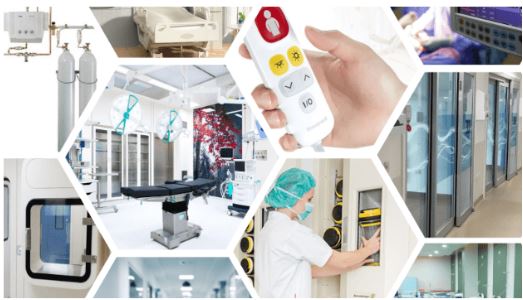
Ultravision’s offerings include complete systems for key infrastructure projects. For example, they install Honeywell nurse call systems (facilitating instant patient–staff communication) and Sumetzberger pneumatic tube systems (PTS) for automated internal logistics. In surgical areas, Ultravision supplies ALVO modular OR suites and ICU doors from Horton, creating flexible, sterile operating theaters in record time. They also partner on MRC cleanroom installations (for labs and pharmacies) and fit medical gas systems and bed head units in patient rooms.
Beyond large projects, Ultravision is known for medical device supply and services. As a certified medical equipment supplier in Dubai and UAE, they carry imaging systems, monitors, ventilators and more to equip hospitals and clinics. In particular, they offer a wide range of ultrasound machines for cardiology, radiology and OB-GYN, ensuring accurate diagnostic imaging. To keep facilities running, Ultravision also provides expert medical equipment repair and maintenance services, with trained technicians minimizing equipment downtime.
In short, Ultravision exemplifies how a hospital systems supplier integrates multiple healthcare solutions under one roof. By delivering everything from advanced hospital medical systems to consumable devices and service support, they help UAE hospitals stay at the forefront of smart, automated care.